Blog

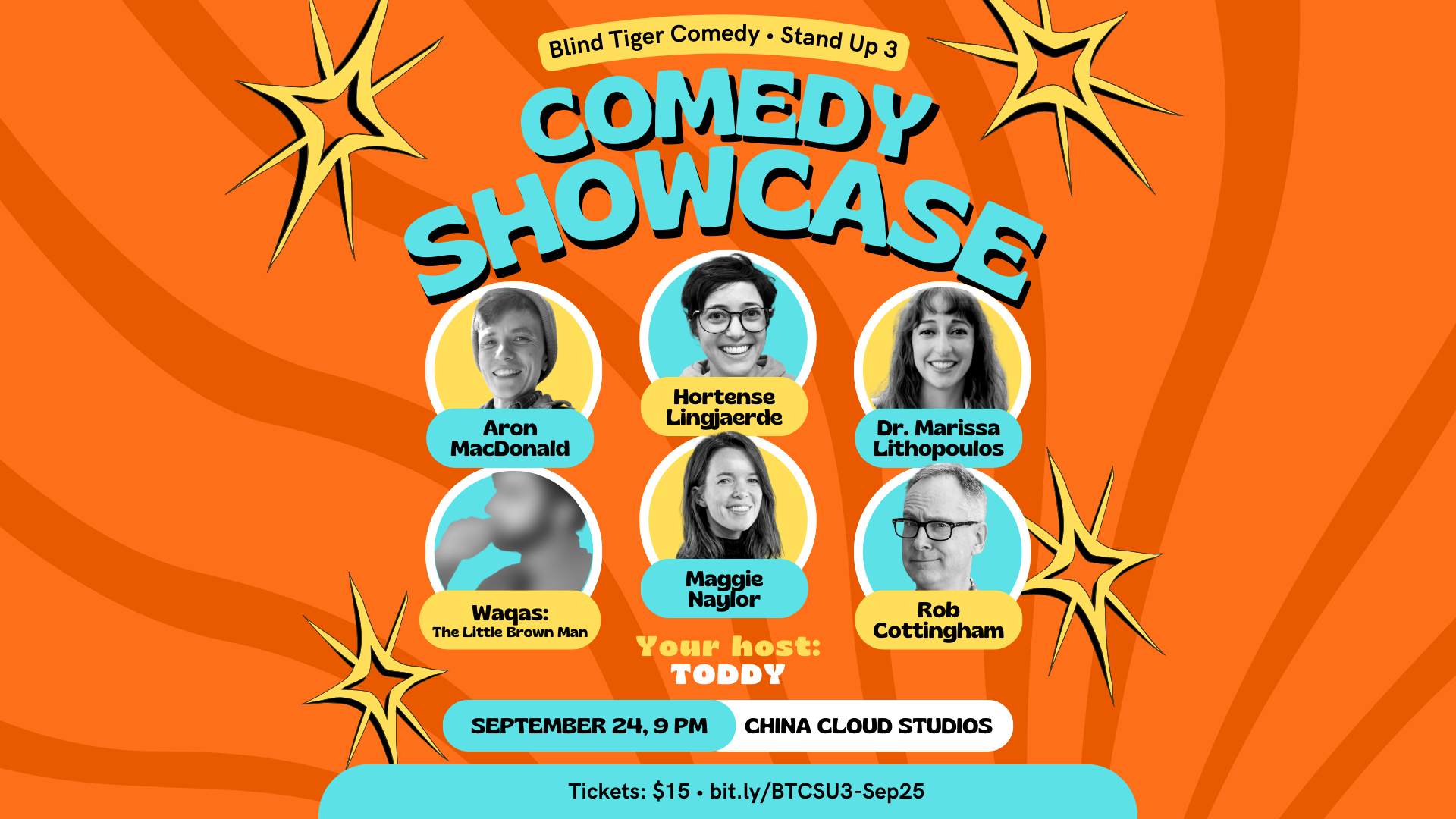
  • Catch me on stage at China Cloud Studio on Sept. 24!

    Catch me on stage at China Cloud Studio on Sept. 24!

    My next set is going to be at China Cloud Studio on Wednesday, September 24 at 9 pm, and I’d be thrilled to see you there!

    It’s part of the showcase from my latest comedy class with Blind Tiger Comedy. You can buy your tickets here; they tend to sell pretty quickly, so be sure to book soon if you’d like to come.

    Hope to see you a week from next Wednesday!

    FAQ:

    What’s the address? China Cloud Studio, 524 Main Street in Vancouver’s Chinatown.

    How many comics are there? There are six of us, plus our host (and mentor!) Toddy. We’ll each be up for about 10 minutes.

    Is the venue accessible? I’m sorry to say it’s whatever the opposite of accessible is. The studio is at the top of two narrow staircases, and there is no elevator. (Wear your fitness tracker — you’ll want credit for the climb.)

    Is the venue licensed? Yes! There’s a cash bar at the back.

    Is there parking? There’s usually street parking quite close, either on Main St. Itself or one of the side streets. And the area is well served by transit.

    Can I bring a friend or two or eight? HELL YES. Please do!

    Would you recommend taking comedy classes at Blind Tiger? With my whole heart, yes. I’ve done classes now in stand up, sketch and improv, and every. single. one. has been terrific. It’s a very supportive environment with experienced instructors who are working in comedy and give you good, honest feedback. See the list of classes here.

  • Leaving so soon?

    Leaving so soon?

    I’ve never actually physically grabbed a speaker. But I’ve been tempted.

    Not because I disagreed with them and wanted them off the stage. The exact opposite, actually: I wanted to keep them from leaving, at least for a few more seconds.

    Those moments come at the end of a speech that’s gone over well. The speaker wraps up and says “Thank you.” And just as the audience begins applauding, the speaker grabs their notes, turns and walks away.

    That’s when I have to restrain myself from running onstage, grabbing them and propelling them back to the front of the stage to accept the damn applause.

    Why are some speakers so eager to flee?

    In some cases, it’s because they’re nervous about speaking, and they want to get off-stage the moment they can.

    Other speakers aren’t 100% convinced they have the right to take up the audience’s time. Consciously or otherwise, they believe their presence on stage is being tolerated, not welcomed. They, too, want to get out of Dodge.

    And even for speakers who are confident both in their abilities and in the audience’s appetite for what they have to say, being applauded can feel awkward. (Ask anyone who has trouble accepting a compliment!)

    That urge to flee the stage is part of something larger: the way we’re taught not to call attention to ourselves. A lot of us have been told all our lives that it’s wrong to seek the spotlight.

    So it can feel at least as wrong to stay there for any longer than absolutely necessary. And our society sends that message more forcefully to some groups of people — like racialized and Indigenous people, women and people with disabilities — than others.

    Oh, won’t you stay-ay-ay, just a little bit longer?

    I’m begging you: stay up there for at least a few more seconds. And if you can’t bring yourself to do it for your own sake, do it for the audience’s.

    Applause is a communal act, and those first few moments after the end of a speech or a performance are critical to how it unfolds. That’s our window as audience members to give each other some social validation.

    You’ve probably seen that in action as an audience member yourself. Yes, some performances get immediate thunderous applause as people leap to their feet cheering the moment the curtain comes down.

    But more often, applause builds as we all come to an unspoken consensus that yeah, that was really great. Give your audience that chance.

    And for that matter, consider it a fair trade. They’ve just spent the last 15, 20 or 30 minutes getting communicated at by you. Give them a chance to communicate back to you.

    So when do you leave?

    Over time, you’ll develop an instinct for sensing when the applause is reaching a plateau. For now, though, take four or five seconds after you wrap (“Thank you” is speechese for “The speech is now over.”)

    That’s enough time to get a sense of the audience’s initial reaction. And even if that reaction is tepid, you at least have time to nod and smile an acknowledgement, then leave.

    But if it’s enthusiastic, linger a little. And if it seems to be building, let yourself show you’re moved by their response. You can wave, say “Thank you” again and generally express your appreciation for theirs.

    You are now free to move about the cabin

    Now you can leave… if you want. (If your gut tells you there’s an ovation coming, and especially if you see people getting to their feet applauding, then stick around.)

    And when you leave, do it confidently. If you have papers, gather them and then stride off-stage. Feel free to give the audience a wave and smile if the vibe is right.

    By the way: find out in advance how they’d like you to leave. Sometimes it’s a straightforward handoff: You leave, the emcee or host heads up to the stage to take the mic, and the two of you greet each other and shake hands or bump elbows in passing.

    Sometimes the host will be with you on the stage as you’re speaking, in which case you can let them drive the timing. (As someone who’s had his share of challenges interpreting social cues, I really appreciate this latter approach.) They may well want to say a few words of thanks to you in front of the audience and present you with a token of their appreciation. (Hope you like pen sets!) Thank them, wave to the audience and stride off, head held high.

    The first several times you make yourself stay onstage for those extra few seconds may feel awkward, even a little scary. I urge you to push through that. Because once you do, I hope you’ll see it as the chance to have one last moment of connection with your audience, and an especially rewarding one.

    This is their moment to tell you that yes, you reached them, and yes, you made a difference. And that’s what this is all about.

    Thank you. …Thanks so much. Really, thank you. Aw, this means so much. Than—… thank you. Oh, my gosh, this is overwhelming. Thank you so very, very much. And good night.

    Photo by Andrew Teoh on Unsplash
  • Your audience doesn’t know what you know. You know?

    Your audience doesn’t know what you know. You know?

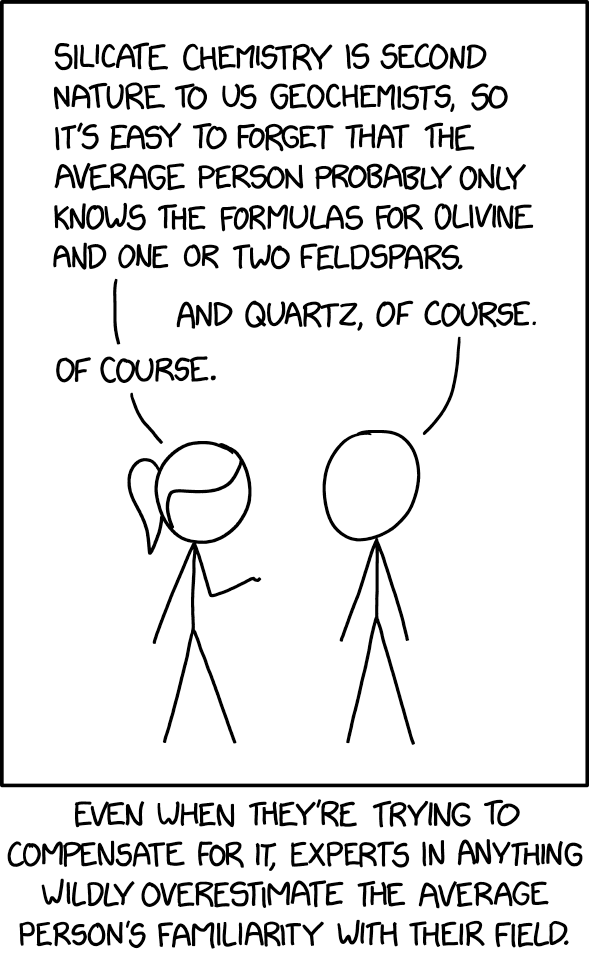
    An XKCD cartoon with two people talking: Person 1: SILICATE CHEMISTRY IS SECOND NATURE TO US GEOCHEMISTS, so IT'S EASY TO FORGET THAT THE AVERAGE PERSON PROBABLY ONLY KNOWS THE FORMULAS FOR OLIVINE AND ONE OR TWO FELDSPARS. Person 2: AND QUARTZ, OF COURSE. Person 1: OF COURSE. Caption: EVEN WHEN THEY'RE TRYING TO COMPENSATE FOR IT, EXPERTS IN ANYTHING WILDLY OVERESTIMATE THE AVERAGE PERSON'S FAMILIARITY WITH THEIR FIELD.This xkcd cartoon by Randall Munroe (see original here) from 2021 hits close to home for this communications practitioner.

    It takes real sustained effort to overcome the curse of knowledge — the tendency to assume the people we’re talking to know the same things we do. It isn’t just the work of overcoming that assumption; it’s the labour of swapping out specialized jargon for plain language, explaining technical concepts or providing crucial background information.

    (And don’t think of it as dumbing your content down: you’re just building the onramps your audience needs to get up to speed.)

    Even then, the work isn’t done. We don’t just have a bias toward assuming people *know* as much as we know about a topic; we have a bias toward believing they *care* as much about it, too.

    So add to our job the work of helping people to understand why this topic that’s so important to us should matter to them as well: connecting it to their own lives and values.

    Unless it’s feldspar, of course. EVERYONE cares about feldspar.

  • When does making people cross the U.S. border become an unconscionable risk?

    When does making people cross the U.S. border become an unconscionable risk?

    For anyone organizing an event with even a slightly international focus, the question of location is suddenly a lot trickier. Crossing the U.S. border today — by land, sea or air — is deeply fraught.

    Anything can trip you up: It could be your race, your sexual orientation, your gender presentation, or your political or social views. It could be your field of study, your circle of friends or just meeting the wrong border agent on the wrong day.

    For whatever reason, you get turned back.

    That’s at best. At worst, you disappear into an increasingly lawless, secretive system of detention.

    This isn’t extrapolation. This isn’t me reading between the lines of Project 2025. This is the actual experience of visitors to the United States today.

    As someone who enjoys conferences and who works with a lot of speakers, I’ve been thinking and talking about this a lot… but not quickly enough to keep up with events. When I began drafting this a few days ago, what I was hearing came from non-American speakers and attendees who were reconsidering attending events in the U.S.

    Now, there’s formal guidance from at least one professional association to avoid non-essential travel to the States.

    Like it or not, this affects your event.

    The implications are wide-ranging, with the most pressing being the threat to the physical safety and liberty of event-goers. And while you might think this isn’t a concern for the average sales convention compared to, say, a sociology conference, I’d suggest that’s self-deluding.

    The pace of authoritarianism can be breathtaking: What’s apolitical this week may be beyond the pale by next Tuesday. And even if your event is “apolitical,” at least some of the people involved are almost certainly not.

    The danger to them doesn’t end with a successful U.S. border crossing. An increasingly bold, aggressive campaign by ICE is seeing people grabbed from the street with little or no recourse — especially given the administration’s contempt for court orders.

    Expect the quality of content and participation at these events to drop steeply. Attendees and speakers will come from an increasingly narrow group of people: those who believe (correctly or otherwise) they aren’t the kind of people who are at risk. And even they will second-guess what they say and do, for fear of coming across the regime’s radar.

    The obvious solution would seem to be to host events outside the U.S. But that, too, puts people in danger: American residents, for whom border crossings are also getting riskier. For many, that’s always been the case, but the peril is now exponentially greater.

    Start acting now to protect your event’s community.

    Safety has always been part of an event organizer’s responsibilities, including fire safety and emergency preparedness, first aid, food safety, codes of conduct and more. This is no exception.

    For now, conscientious organizers will want to begin consulting with speakers and attendees about how to best accommodate their safety concerns. Part of the solution will almost certainly be robust hybrid events, offering as rich and complete an online experience as possible.

    But the answer also has to include taking a stand against this appalling abuse of power. There’s a solid business case that event conveners can make against it in their lobbying. But even more important than that is the fact that so many people are being threatened and terrorized; their freedoms violated; their lives turned upside down.

    I’ve lost count of the number of events I’ve been to where the hosts talk about their conference, summit or convention as a community. Well, a community stands up — and speaks up — for its members. And it doesn’t put them at unconscionable risk.

    This is about safety. But it’s also about solidarity.

    (Photo by Red Dot on Unsplash)

  • We’re not here to be your electoral fantasy, America

    We’re not here to be your electoral fantasy, America

    Most Canadians have taken it as read that Donald Trump’s raving about our country becoming the 51st state is just limited to him. We’ve assured each other that, apart from the fanboy retinue that echoes everything he says, the vast majority of Americans support Canadian sovereignty. When push came to shove, we tell ourselves — whether it involved military force and annexation or just the kind of economic coercion — that vast majority would stand with us.

    Our faith was more than a little shaken by Tuesday’s New York Times piece by Peter Baker quoting a former chair of the Democratic Congressional Campaign Committee, Steve Israel, saying “I strongly agree with Donald Trump.”

    Annexing Canada, he said, “means more Democrats in Congress and Electoral College votes, not to mention providing universal health care and combating climate change.”

    Bear in mind, Israel isn’t some Tulsi Gabbard-esque fringe member of his party. He was an eight-term member of the House of Representatives, serving as assistant whip and chairing the House Democratic Caucus Task Force on Defense and Military.

    And here he is treating a direct threat against an independent nation, America’s closest ally and its largest trading partner as though it’s either a fun electoral math exercise or — worse — something to be favourably considered.

    The online reaction from the Americans I know and follow has been reassuringly outraged. But reading this article shakes me to my core, as do passages in the article like “the notion of Canada as a state, however farcical and unlikely, has intrigued the political class and been the source of parlor games in Washington.”

    Your president is openly talking about naked aggression against your best friend on the planet, and you’re “intrigued”?

    Now, maybe Israel and company couched what they said in vocal condemnations of the very idea of violating an ally’s sovereignty. But you don’t get to be a Steve Israel without knowing that context gets stripped from quotes all the time. He’s media-savvy enough to know what he was saying.

    To be generous, maybe some of the folks quoted in this article (and others posting gleeful Electoral College scenarios on Bluesky and LinkedIn) think they’re helping by making Canada look less electorally attractive to Republicans. But the very fact that they’re entertaining the idea at all — that they’re mulling over the practical upside of the unthinkably wrong — normalizes it. They’re making it respectable. And it’s a very short walk from the realm of “what if” to the cold, hard world of “how to.”

    And to those who like the thought of absorbing Canada because the electoral math might yield more progressive outcomes: that’s a solid no from us. Our country isn’t some emergency epi-pen for broken electoral systems. Voter suppression, gerrymandering, corporate manipulation and the Electoral College are all serious issues, but they’re your issues. You can have our support and our sympathy… just not our sovereignty.

    Canadians have been attuned to American politics for as long as there’s been a Canada. We have to be. We’ve been alarmed by Trump’s rise for your sake even more than for ours; we care what happens to you.

    But today we’re watching and listening more closely than ever before, with grave, immediate concern for our own future. Some of us are terrified; almost all of us are furious.

    And America, we’re noticing what you’re saying.

    I am doing my best, as are many of us, to convince friends and neighbours that the great majority of Americans aren’t with Trump on this. Even as we await the imposition of tariffs that will deal a brutal blow to our economy, I’m telling them that most of you are as horrified as we are by what he’s proposing, and as determined as we are to make sure it never happens.

    But that can be a hard sell when even some Democrats are talking about carving us up for congressional advantage.

    If you’re an American appalled by Donald Trump’s designs on Canada, this would be a very good day for Canadians to hear from you. And if you’re Steve Israel, this would be an excellent day to stop giving interviews for a while.

  • Ep. 75. Getting back on track

    Ep. 75. Getting back on track

    Getting carried off on a tangent in an interview or Q&A session can be risky. At best, you spend the time you wanted to use getting your message across on some other topic. At worst, you end up talking about sensitive, damaging topics that endanger your organization’s reputation.

    This episode, we look at how you get back on track — quickly, honesty and graciously.

    Music: All music is by Lee Rosevere. The theme music is “Twitter Will Kill Us All.” Used under a Creative Commons license.

    Photo: Zane Lee on Unsplash

    Listen here.

    [iframe style=”border:none” src=”//html5-player.libsyn.com/embed/episode/id/26751486/height/100/width//thumbnail/no/render-playlist/no/theme/custom/tdest_id/3958356/custom-color/87A93A” height=”100″ width=”100%” scrolling=”no” allowfullscreen webkitallowfullscreen mozallowfullscreen oallowfullscreen msallowfullscreen]

  • Ep. 74 Why you need to rehearse — and how

    Ep. 74 Why you need to rehearse — and how

    Rehearsal doesn’t kill spontaneity — it gives you the confidence that lets you be spontaneous. You don’t just know the material: you know its emotional and literal meaning,nd you’ve made your big choices about how you’re going to convey it.

    If you want to make the most of your speech, you need to rehearse. And to make that rehearsal count, behold: The Ten Commandments of Rehearsal.

    Links:

    Music: All music is by Lee Rosevere. The theme music is “Twitter Will Kill Us All.” Used under a Creative Commons license.

    Photo:  Photo by Kyle Head on Unsplash

  • Ep. 73 No more boring speaker introductions!

    Ep. 73 No more boring speaker introductions!

    [iframe style=”border:none” src=”//html5-player.libsyn.com/embed/episode/id/23520230/height/100/width//thumbnail/no/render-playlist/no/theme/custom/tdest_id/1040228/custom-color/1e73be” height=”100″ width=”100%” scrolling=”no” allowfullscreen webkitallowfullscreen mozallowfullscreen oallowfullscreen msallowfullscreen]
    Listen here

    Before a speaker steps up to the microphone, there’s usually somebody who introduces them. And that introduction could be helping to set the stage and prime the audience.

    But too many speaker introductions are just tedious recitals of a speaker’s biography. And they’re so loooonnnng. Instead of revving an audience up, they put them to sleep. Let’s kill those introductions off once and for all. This episode, we look at what an introduction can do for you and your audience, by promising some combination of six elements: authority, affinity, attraction, value, intrigue and entertainment. We’ll talk about how to make your speaker intro effective, engaging and — most important — short!

    Music:

  • Ep. 72 Dana Rubin is Speaking While Female

    Ep. 72 Dana Rubin is Speaking While Female

    [iframe style=”border:none” src=”//html5-player.libsyn.com/embed/episode/id/22292963/height/100/width//thumbnail/no/render-playlist/no/theme/custom/tdest_id/1040228/custom-color/1e73be” height=”100″ width=”100%” scrolling=”no” allowfullscreen webkitallowfullscreen mozallowfullscreen oallowfullscreen msallowfullscreen]
    Listen here

    Pick up a collection of speeches or quotations from history, and chances are most of those voices belong to men.

    That’s changing. More women are claiming their time at the microphone. And it turns out the oratory of the past was a lot more female than many of its curators would have us think.

    One woman in particular, Dana Rubin, is working to change our understanding of public speaking history — and the role women have played in shaping it. And she’s my guest on this episode.

    Links:

    Music:


  • Ep. 71 Get out of your lane

    Ep. 71 Get out of your lane

    [iframe style=”border:none” src=”//html5-player.libsyn.com/embed/episode/id/20839610/height/100/width//thumbnail/no/render-playlist/no/theme/custom/tdest_id/1040228/custom-color/1e73be” height=”100″ width=”100%” scrolling=”no” allowfullscreen webkitallowfullscreen mozallowfullscreen oallowfullscreen msallowfullscreen]
    Listen here

    You’ve probably heard the expression “stay in your lane.” And sometimes that’s good advice — but right now, we’re facing global emergencies on an unprecedented scale, and we need voices speaking out for truth, democracy, science and our very survival. If you have a platform, you can be one of those voices…even if you aren’t an expert. Here’s how to do it responsibly.

    Links:

    Music:


  • Ep. 70 Find Your Red Thread with Tamsen Webster

    Ep. 70 Find Your Red Thread with Tamsen Webster

    [iframe style=”border:none” src=”//html5-player.libsyn.com/embed/episode/id/19964660/height/100/width//thumbnail/no/render-playlist/no/theme/custom/tdest_id/1040228/custom-color/1e73be” height=”100″ width=”100%” scrolling=”no” allowfullscreen webkitallowfullscreen mozallowfullscreen oallowfullscreen msallowfullscreen]Listen here

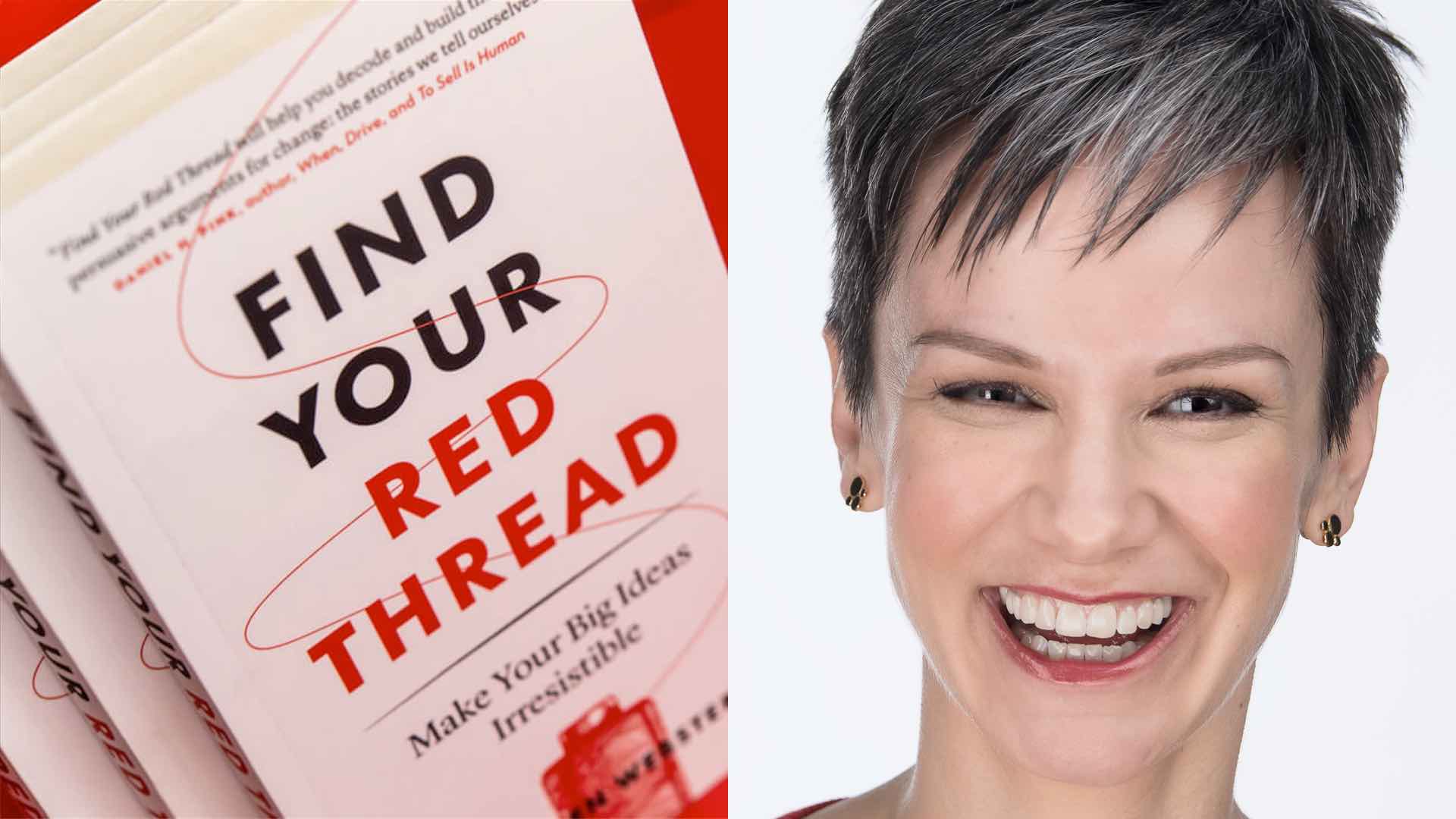
    There probably isn’t a speechwriter or speaker alive today who hasn’t heard the advice “Tell a story.” But you want them to do more than listen. You want to tell the kind of story your audience will turn into their story. Crafting that story is the heart Tamsen Webster’s terrific new book, Find Your Red Thread. Tamsen joins me this episode to talk about the five steps of an effective Red Thread — which just so happen to be a great way to outline your next speech or op-ed. And we talk about how great stories can move audiences and create change.

    Links:

    Music: All music is by Lee Rosevere. The theme music is “Twitter Will Kill Us All.” Used under a Creative Commons license.

  • Ep. 69 Seven deadly sins of online presentation (part two)

    Ep. 69 Seven deadly sins of online presentation (part two)

    [iframe style=”border:none” src=”//html5-player.libsyn.com/embed/episode/id/19865066/height/100/width//thumbnail/no/render-playlist/no/theme/custom/tdest_id/1040228/custom-color/1e73be” height=”100″ width=”100%” scrolling=”no” allowfullscreen webkitallowfullscreen mozallowfullscreen oallowfullscreen msallowfullscreen] Listen here

    Well over a year into remote presentations as the norm, people are getting pretty good at it… but some mistakes are still cropping up again and again.

    Last time, we looked at four of the seven deadly sins of online presentations. This time we tour the final three… and then we’ll look at how to flip those sins into shining, saintly virtues.

    Music: All music is by Lee Rosevere. The theme music is “Twitter Will Kill Us All.” Used under a Creative Commons license.

    Photo: Cullan Smith on Unsplash